Table of Contents
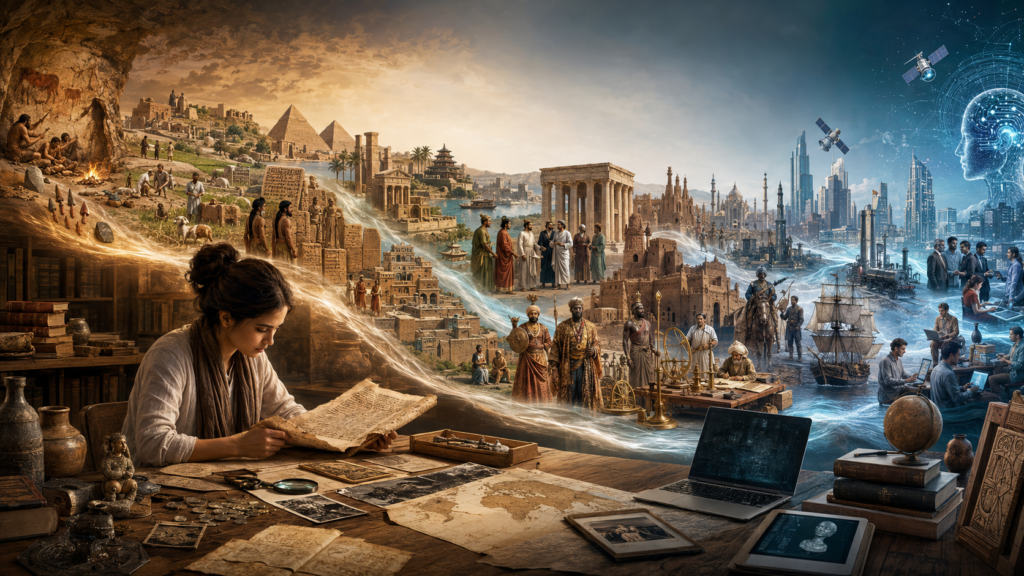
Every person enters a world already shaped by events they did not witness. The language we speak, borders surrounding us, laws governing us, beliefs guiding us, and technologies connecting us all emerged through long processes of human action and change. Even our disagreements about identity, justice, religion, nationhood, and progress possess histories.
But what is history?
History is not simply everything that happened before today. Nor is it merely a list of kings, wars, empires, inventions, and dates. It is humanity’s disciplined attempt to investigate, reconstruct, interpret, and explain the past through surviving evidence.
A historian asks not only, “What happened?” but also:
- Why did it happen?
- Who participated, benefited, or suffered?
- What evidence supports the account?
- Whose voice has been preserved?
- Whose experience is missing?
- What changed, and what remained?
- Why do historians disagree about its meaning?
History is therefore both a body of knowledge and a method of inquiry. It connects evidence from the past with questions asked in the present.
What Does the Word “History” Mean?
The English word history comes through Latin from the ancient Greek word historia, associated with inquiry, investigation, and knowledge acquired through examination. This origin is important: history originally implied an active search for knowledge rather than passive memorization.
The Greek historian Herodotus used inquiry, travel accounts, oral testimony, geography, and storytelling to investigate the conflict between the Greek city-states and the Persian Empire. Thucydides adopted a more analytical approach in explaining the Peloponnesian War, concentrating on human decisions, political interests, power, and causation.
However, historical consciousness did not begin or end in Greece. Civilizations around the world developed their own methods for remembering and interpreting the past.
Chinese historian Sima Qian assembled political, biographical, chronological, and cultural records in the Shiji. Muslim historians such as al-Tabari preserved reports and chains of transmission, while Ibn Khaldun critically examined the social forces behind the rise and decline of states. African societies preserved historical knowledge through oral traditions, genealogies, performance, material culture, and collective memory. South Asian traditions recorded dynasties, religious developments, court life, biographies, inscriptions, and regional experiences.
History has always been a global human activity, even though different societies have recorded and understood it differently.
The Past and History Are Not the Same
People often use “the past” and “history” as though they mean the same thing. They are closely connected but fundamentally different.
| The past | History |
|---|---|
| Everything that has already happened | A reasoned reconstruction of selected aspects of the past |
| Cannot be directly revisited | Studied through surviving evidence |
| Includes all human experiences | Includes what historians can investigate and explain |
| Exists independently of historians | Produced through research, selection, and interpretation |
| Much of it has disappeared | Always limited by available sources |
Imagine a marketplace that existed 1,000 years ago. Thousands of conversations, purchases, arguments, friendships, smells, sounds, and personal experiences occurred there. All these belonged to the past.
Only a small portion might survive: coins, broken pottery, building foundations, tax records, travelers’ descriptions, or stories passed between generations. Historians use these traces to reconstruct part of the marketplace’s history. They cannot recover every moment exactly as it occurred.
The past is therefore unlimited, but historical knowledge is selective and evidence-dependent.
How Major Historians Have Understood History
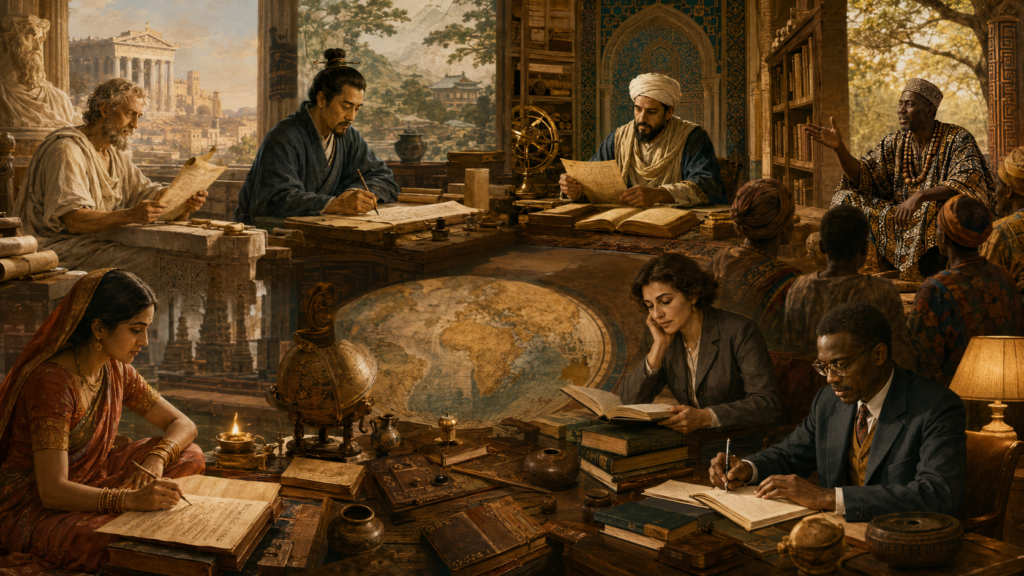
There has never been a single definition accepted by every historian. Historical thought has changed because scholars have asked different questions and worked within different intellectual traditions.
| Historian or tradition | Central approach to history |
|---|---|
| Herodotus | Inquiry into human actions, cultures, conflicts, and memorable events |
| Thucydides | Critical investigation of politics, war, power, motives, and causation |
| Sima Qian | A connected record of rulers, institutions, personalities, and moral choices |
| Al-Tabari | Preservation and organization of transmitted historical reports |
| Ibn Khaldun | Critical analysis of society, power, solidarity, economy, and dynastic change |
| Leopold von Ranke | Careful archival research and reconstruction from primary documents |
| Karl Marx | Historical change shaped strongly by material conditions and class relations |
| R. G. Collingwood | Understanding past actions by reconstructing their reasoning and intentions |
| Marc Bloch | Study of human beings and societies across time |
| Fernand Braudel | Long-term geographical, economic, and social structures |
| Arnold Toynbee | Comparative study of the development and breakdown of civilizations |
| E. H. Carr | Continuing interaction between historians, evidence, and present questions |
| Joan Wallach Scott | Gender as a category for analysing social relations and power |
| Ranajit Guha | Recovery of subordinated groups overlooked by colonial and elite narratives |
| Michel Foucault | Historical relationships among knowledge, institutions, discourse, and power |
| Hayden White | The influence of narrative form on historical representation |
Herodotus broadened historical inquiry by recording cultures and traditions, although his work sometimes combined observation, testimony, and stories that modern historians would examine cautiously. Thucydides placed greater emphasis on political calculation, eyewitness investigation, and human causation.
Sima Qian demonstrated that history could combine chronology with biography, institutional analysis, and moral reflection. Al-Tabari’s extensive compilation preserved variant reports rather than always reducing the past to a single narration.
Ibn Khaldun offered one of history’s most original methodological interventions. In the Muqaddimah, he warned against accepting transmitted reports without considering social reality, human behavior, political interests, and whether an event was reasonably possible. He examined how group solidarity, authority, economic life, and luxury could shape dynastic change.
During the nineteenth century, Leopold von Ranke helped strengthen archival research and source criticism. His approach encouraged historians to reconstruct past events from documents rather than imposing an abstract moral scheme upon them.
Karl Marx shifted attention toward production, labor, property, class relations, and conflict. Although economic conditions cannot explain every aspect of history, Marxist historiography greatly expanded the study of workers, institutions, inequality, and material life.
R. G. Collingwood argued that historians seek to understand actions from within by reconstructing the intentions and reasoning of historical actors. Historical inquiry therefore differs from simply observing physical events. The Internet Encyclopedia of Philosophy explains that Collingwood distinguished historical understanding of human decisions from external descriptions of events.
Marc Bloch and the Annales tradition widened history beyond political events. Fernand Braudel examined long-term structures—geography, trade, climate, demography, and material life—that may change more slowly than governments.
Later approaches questioned whose experiences conventional histories had excluded. Joan Wallach Scott demonstrated how gender can reveal structures of power rather than merely adding women to an existing narrative. Ranajit Guha and Subaltern Studies challenged both colonial and elite nationalist accounts of South Asia and attempted to recover the historical agency of subordinated populations. Cambridge University Press describes Guha’s work as a critique of both colonialist and nationalist historiography.
African historians similarly challenged narratives that treated Africa as a continent without history. UNESCO’s General History of Africa brings together archaeology, linguistics, written records, material evidence, and oral traditions to examine Africa through African perspectives. The project involved hundreds of African and international scholars and highlighted the importance of oral evidence in historical research. UNESCO
These approaches do not make earlier historical research useless. They demonstrate that history grows when scholars introduce new evidence, methods, questions, regions, and human experiences.
Is History a Record, an Inquiry, or an Interpretation?
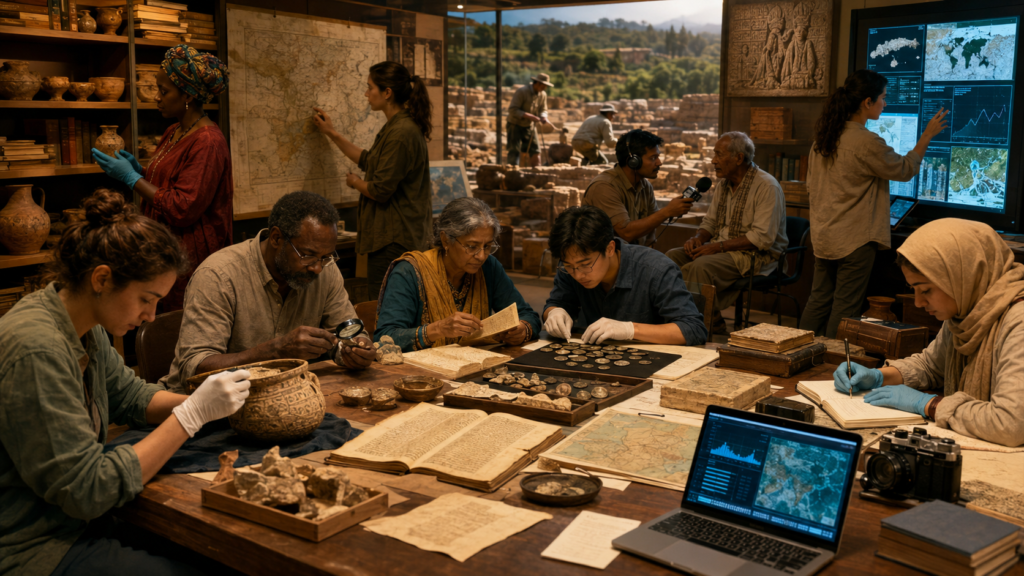
History performs all three functions.
First, it creates a record. Historians preserve knowledge of events, institutions, communities, environments, and individuals that might otherwise be forgotten.
Second, history is an inquiry. Historians search archives, excavate sites, examine objects, compare testimony, evaluate authenticity, establish chronology, and test explanations.
Third, history is interpretation. Evidence rarely explains itself. A grain-price record may indicate economic conditions, but historians must determine why prices changed and how the changes affected different groups. A ruler’s proclamation reveals official policy, but it may not reveal whether people obeyed it.
E. H. Carr described historical knowledge as an interaction between historians and their facts. His point was not that facts are imaginary. Rather, historians select facts, connect them, and determine their significance through questions. A complete list of unrelated facts would not yet constitute a meaningful history.
Interpretation must nevertheless remain accountable to evidence. A historian may present a new explanation, but cannot responsibly invent events, suppress contrary sources, or alter dates merely to support a preferred argument.
What Is the Purpose of History?

Understanding identity
History helps individuals and communities understand how their identities developed. Family histories, migrations, languages, religious traditions, political movements, and national institutions connect people with earlier generations.
Historical identity should not become blind pride. Mature historical understanding recognizes achievements, failures, diversity, exchange, conflict, and change.
Explaining the present
Institutions do not appear suddenly. Legal systems, borders, economic inequalities, educational structures, and international conflicts are products of earlier decisions and conditions. Without history, the present appears isolated and confusing.
Understanding change and continuity
History examines why certain institutions disappear while others survive. It can show that practices considered “natural” or permanent were created in particular circumstances—and may therefore change again.
Developing critical thinking
Historical study teaches readers to examine authorship, context, purpose, audience, silence, contradiction, and bias. The American Historical Association describes historical thinking as constructing persuasive explanations through logical interpretations of evidence. American Historical Association
Challenging misinformation
Propaganda often depends on selective memory, invented traditions, misleading comparisons, or emotionally powerful myths. Historical literacy helps people ask whether a claim is supported, whether evidence has been removed from context, and whether alternative experiences have been excluded.
Understanding other societies
Studying different civilizations reduces the temptation to treat one society’s experience as the universal pattern. It shows that human communities have organized family, government, trade, belief, education, and justice in many ways.
Learning without expecting repetition
The statement “history repeats itself” is misleading. Similar forces—fear, ambition, inequality, rivalry, technological disruption, or competition for resources—may appear repeatedly, but circumstances are never identical.
History offers comparisons, warnings, possibilities, and perspectives, not mechanical predictions.
Why History Matters in 2026

Historical knowledge is particularly important in a world of instant communication and fragmented attention. Digital platforms can circulate accurate information, but they can also spread fabricated quotations, manipulated images, decontextualized videos, and simplified accounts of complicated conflicts.
Artificial intelligence has made the rapid production of text and images easier. It has also increased the importance of verifying provenance: Who created a document? When was it produced? Has it been altered? Is the cited source genuine?
Current debates about war, nationalism, colonialism, migration, religious identity, climate change, inequality, monuments, and territorial claims frequently depend upon competing accounts of the past. Historical understanding does not automatically resolve these conflicts, but it prevents complex developments from being reduced to slogans.
Climate history, for example, investigates past droughts, floods, harvest failures, disease environments, and human adaptations. The history of technology shows that innovations transform societies through institutions, labor systems, political choices, and unequal access—not through machines alone.
To understand 2026, we must therefore study much more than events occurring in 2026. The present contains layers of earlier history.
What Is the Scope of History?
The scope of history includes human experience across all periods and geographical regions.
Chronological scope
- Prehistory: Human life before the appearance of readable written records in a particular society.
- Protohistory: A transitional condition in which a society may be mentioned by literate neighbors or possess writing that cannot yet be fully interpreted.
- Ancient history: Early states and civilizations after the emergence of writing.
- Medieval or post-classical history: The period following the ancient world, defined differently across regions.
- Early modern history: The age of expanding empires, global exchange, religious transformation, printing, and scientific change.
- Modern history: Usually associated with industrialization, revolutions, nationalism, imperialism, and modern states.
- Contemporary history: The recent past, often including events still within living memory.
These categories are useful but imperfect. The Bronze Age did not begin everywhere simultaneously; neither did the medieval or modern period. A global blog must avoid applying European period boundaries mechanically to Africa, Asia, the Americas, or Oceania.
Major Branches of History
| Branch | Principal focus |
|---|---|
| Political history | States, rulers, parties, elections, administration, and political movements |
| Social history | Communities, classes, families, work, education, and everyday life |
| Cultural history | Symbols, customs, language, art, rituals, and shared meanings |
| Economic history | Production, trade, labor, money, taxation, and economic institutions |
| Intellectual history | Ideas, philosophies, knowledge, and scholarly debates |
| Religious history | Beliefs, institutions, practices, reform, and interreligious relations |
| Military history | Warfare, strategy, armed institutions, soldiers, and civilian consequences |
| Diplomatic history | Relations, negotiations, alliances, treaties, and international systems |
| Legal history | Laws, courts, constitutions, rights, and concepts of justice |
| History of science | Development of knowledge, medicine, discovery, and scientific institutions |
| Environmental history | Relationships among humans, climate, animals, landscapes, and resources |
| Gender history | Gender roles, identities, power relations, and lived experiences |
| Labour history | Workers, occupations, unions, migration, and workplace conditions |
| Medical history | Disease, health systems, treatments, disability, and public health |
| Art history | Visual expression, architecture, patronage, materials, and aesthetics |
| Oral history | Recorded memories and testimony of people who experienced the past |
| Public history | History presented through museums, archives, monuments, media, and heritage sites |
| Global history | Connections, exchanges, migrations, and processes crossing regions |
| Microhistory | Intensive investigation of a small event, person, place, or community |
| Digital history | Digital sources, databases, mapping, visualization, and computational methods |
The expansion of these branches has transformed the discipline. History now studies not only emperors and generals but also farmers, workers, healers, enslaved people, women, children, migrants, craftspeople, Indigenous communities, and other groups frequently absent from official records.
The Geographical Scope of History
A genuine history of humanity cannot use Europe as its only center. It must include Africa, Asia, Europe, the Middle East, Central Asia, South Asia, the Americas, Oceania, and Indigenous worlds.
Nor should these regions be presented as isolated containers. Civilizations have always been connected through migration, trade, conquest, diplomacy, pilgrimage, disease, environmental change, translation, and the movement of ideas.
The Silk Roads connected East Asia, Central Asia, South Asia, the Middle East, Africa, and Europe. Indian Ocean networks linked merchants and communities long before modern European imperialism. African societies participated in continental and transoceanic exchanges. Muslim scholars preserved, criticized, and developed knowledge drawn from Greek, Persian, Indian, and other traditions.
Global history does not erase local difference. It studies how local societies shaped wider connections—and how those connections transformed local life.
How Do Historians Reconstruct the Past?
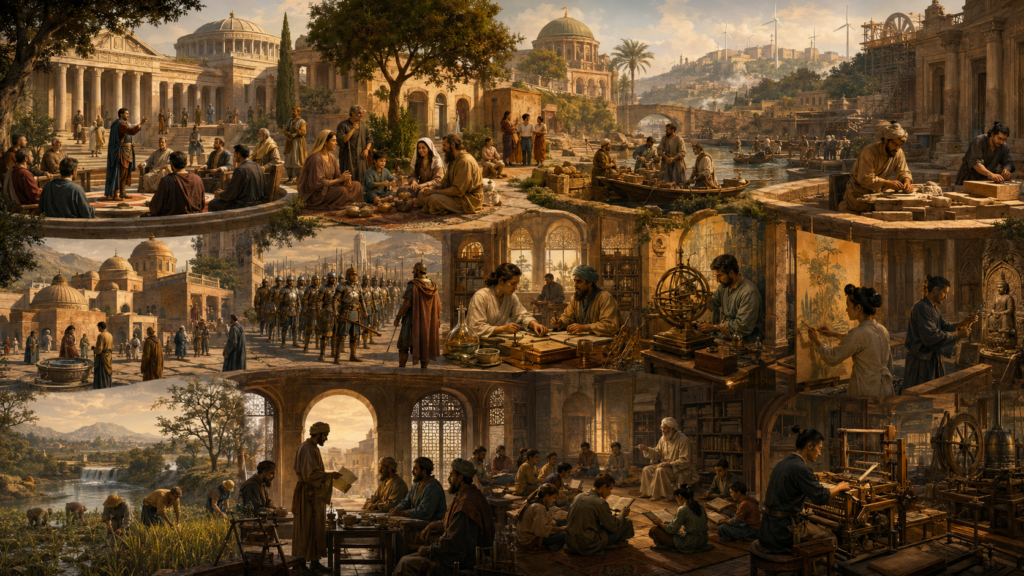
Historians work with many forms of evidence:
- Official documents and legal records
- Letters, diaries, and memoirs
- Newspapers and books
- Inscriptions and manuscripts
- Coins, tools, pottery, and weapons
- Buildings, roads, graves, and settlements
- Paintings, sculptures, textiles, and maps
- Oral traditions and recorded testimony
- Photographs, films, and sound recordings
- Census, trade, tax, and population data
- Digital communications and websites
- Linguistic evidence
- Genetic and biological evidence
- Climatic and environmental records
A primary source was created during—or close to—the period being investigated. A secondary source is a later analysis based on primary evidence and earlier scholarship.
Neither category guarantees truth. A primary source may contain prejudice, propaganda, error, exaggeration, or incomplete information. A later secondary study may compare many sources and offer a more reliable explanation.
Historians therefore evaluate provenance, authorship, date, audience, purpose, authenticity, context, and consistency. They compare independent evidence rather than depending on a single document.
Historical Facts, Selection, and Interpretation
Some historical statements are firmly established. The Second World War ended in 1945, for example. But historians can still debate its causes, turning points, social effects, moral responsibilities, and long-term consequences.
Selection is unavoidable because no historian can include everything. The important question is whether the selection is transparent, reasonable, and representative of the available evidence.
Responsible interpretation:
- Identifies its sources
- Acknowledges uncertainty
- Considers contrary evidence
- Separates fact from inference
- Avoids misleading omissions
- Remains open to correction
Historical distortion does the opposite. It changes, invents, conceals, or selectively uses evidence to protect a political, ideological, religious, or commercial interest.
Can History Be Objective?
Complete neutrality may be impossible because historians choose questions, sources, concepts, and narrative structures. Their interests are influenced by their society and period. The Stanford Encyclopedia of Philosophy identifies selection, interpretation, omission, values, and perspective as central problems in debates about historical objectivity.
This does not mean that all accounts are equally valid.
Historical reliability can be strengthened through:
- Source criticism
- Independent corroboration
- Accurate citation
- Archaeological and scientific testing
- Transparency about uncertainty
- Peer review
- Comparison of competing explanations
- Revision when new evidence appears
Objectivity is best treated as a disciplined standard: historians must try to prevent personal preference from overriding evidence. Different interpretations can coexist, but they must remain answerable to what the surviving evidence permits.
History, Memory, Myth, and Propaganda
| Concept | Meaning |
|---|---|
| History | Evidence-based investigation and interpretation of the past |
| Personal memory | An individual’s recollection of experience |
| Collective memory | A group’s shared understanding of its past |
| Myth | A meaningful traditional narrative that may not be historically factual |
| Legend | A story connected to people or events but shaped through transmission |
| Heritage | Elements of the past preserved and valued in the present |
| Propaganda | Selective or misleading communication designed to influence attitudes |
Memory is historically valuable but fallible. People forget, combine events, reinterpret experiences, and absorb later information. Oral testimony must be respected while also being evaluated in context.
Myths may express cultural identity, moral values, or sacred meaning without functioning as verifiable historical accounts. Historians should neither mock them nor automatically treat them as factual evidence.
Myth Versus Evidence
Myth: History is written only by the victors.
Evidence: Victors often control official records, but archaeologists, oral historians, social historians, and other researchers can recover suppressed or marginalized experiences.
Myth: History always repeats itself.
Evidence: Patterns may recur, but each event develops under different conditions.
Myth: A primary source tells exactly what happened.
Evidence: Every source has a creator, purpose, audience, and limitation.
Myth: Interpretation means that historical truth does not exist.
Evidence: Interpretation operates within evidential limits. Some explanations are much better supported than others.
Myth: History is mainly about memorizing dates.
Evidence: Dates provide chronology; historical understanding requires explanation, comparison, causation, and evaluation.
Common Misconceptions About History
History is not limited to politics and warfare. It includes food, family, emotion, labor, disease, education, environment, technology, and ordinary life.
Historians cannot recover every detail of the past. Evidence is always incomplete, and some people left fewer records than others.
Older accounts are not automatically superior. New evidence or methods may correct them. Newer interpretations, however, are not automatically correct either; they must still demonstrate evidential strength.
Finally, history is not a warehouse of ready-made moral lessons. It improves judgment by revealing complexity, unintended consequences, different possibilities, and the limits of simple explanations.
Conclusion: Humanity’s Shared Inquiry
History is the disciplined, evidence-based investigation of human experience across time. It studies change and continuity, connects past and present, and explains how societies, institutions, identities, and ideas developed.
It is simultaneously a record, an inquiry, and an interpretation—but never a license to invent the past.
Studying history requires curiosity because the human past is immense; humility because much has been lost; empathy because earlier people lived under circumstances different from our own; and critical judgment because evidence must always be evaluated.
Most importantly, history belongs to all humanity. It includes powerful rulers and forgotten workers, written archives and oral traditions, famous civilizations and communities once pushed to the margins.
Having established what history means, we can now approach the first great division of the human journey: Prehistory, Protohistory, and Recorded History—How the Human Past Is Divided.
Key Takeaways
- The past includes everything that happened; history is its evidence-based reconstruction.
- History investigates causes, consequences, change, continuity, and human experience.
- Historians select and interpret evidence, but their interpretations remain accountable to facts.
- History includes every region and every aspect of human life.
- Historical thinking helps identify propaganda, misinformation, and oversimplification.
- Absolute neutrality may be difficult, but reliable historical knowledge remains possible.
- History is a continuing global conversation between evidence from the past and questions from the present.
Frequently Asked Questions
1. What is the simplest definition of history?
History is the evidence-based study and interpretation of the human past.
2. Who is called the father of history?
Herodotus is traditionally called the “father of history,” although many civilizations developed independent traditions of historical recording.
3. Is history the same as the past?
No. The past is everything that happened, while history is what people can reconstruct and explain using surviving evidence.
4. Is history a science or an art?
History contains elements of both. It uses systematic methods for evaluating evidence but also requires interpretation and clear narrative explanation.
5. Can historians be completely objective?
Complete neutrality is difficult, but historians can produce reliable knowledge through source criticism, corroboration, transparency, and peer review.
6. Why do historians disagree?
They may use different evidence, ask different questions, emphasize different causes, or apply different methods. Disagreement is legitimate when interpretations remain evidence-based.
7. Why should we study history?
History helps us understand identity, institutions, social change, other cultures, present-day problems, and the consequences of human choices.
8. What is historiography?
Historiography is the study of how history has been researched, interpreted, and written.
Glossary
- Archive: A collection of preserved historical records.
- Chronology: The arrangement of events in time order.
- Corroboration: Comparing independent evidence to test a claim.
- Historiography: The study of historical writing and interpretation.
- Oral history: Recorded testimony about remembered experiences.
- Periodization: Dividing the past into named historical periods.
- Primary source: Evidence produced during or near the period studied.
- Provenance: The origin and history of a document or object.
- Secondary source: A later interpretation based on historical evidence.
- Source criticism: Systematic evaluation of the authenticity, context, and reliability of evidence.
Recommended Reading
- Bloch, Marc. The Historian’s Craft.
- Braudel, Fernand. On History.
- Carr, E. H. What Is History?
- Collingwood, R. G. The Idea of History.
- Guha, Ranajit, and Gayatri Chakravorty Spivak, eds. Selected Subaltern Studies.
- Ibn Khaldun. The Muqaddimah.
- Scott, Joan Wallach. “Gender: A Useful Category of Historical Analysis.”
- Tosh, John. The Pursuit of History.
- UNESCO. General History of Africa, Volume I: Methodology and African Prehistory.
References
American Historical Association. “Why Study History?” AHA.
American Historical Association. “What Does It Mean to Think Historically?” AHA.
D’Oro, Giuseppina. “Robin George Collingwood.” Stanford Encyclopedia of Philosophy. Stanford University.
Gopal, Priyamvada. “Reading Subaltern History.” In The Cambridge Companion to Postcolonial Literary Studies. Cambridge University Press.
Little, Daniel. “Philosophy of History.” Stanford Encyclopedia of Philosophy. Stanford University.
O’Hanlon, Rosalind. “Recovering the Subject: Subaltern Studies and Histories of Resistance in Colonial South Asia.” Modern Asian Studies 22 (1). Cambridge University Press.
Scott, Joan Wallach. “Gender: A Useful Category of Historical Analysis.” American Historical Review 91 (5): 1053–1075. Bibliographic record available through Oxford Research Encyclopedias.
UNESCO. General History of Africa. UNESCO.